The Last Board Standing · Part 3 of 3
The Last Seat
In the final round, the roles reversed. Savitha was the one who was lost.
Over the first two parts, we saw Savitha Shri, a teenager on her Olympiad debut, win two games from the last seat at the table. Against Kazakhstan, her opponent played not to lose. Against China, both sides shied away from the same exchange sacrifice.
Then came the final round, and everything flipped.
Game 3: Georgia
Once again, it came down to Savitha in the final round. The match stood at 1.5-1.5, and India needed a win for silver. A draw meant bronze, and a loss meant finishing outside the top five. She was on 8.5/9, but none of that would matter if she lost. People have short memories, and it would have been easy to pin the result on her.
This time the roles were reversed. Savitha had Black against Meri Arabidze, and she was completely lost.
For me, it was heartbreaking to watch this game. I felt terrible for her, because I was sure she was going to lose. We had fought so hard and come so close, but it looked like we would go home with nothing to show for it. After a point, I basically stopped watching.
What should White play?
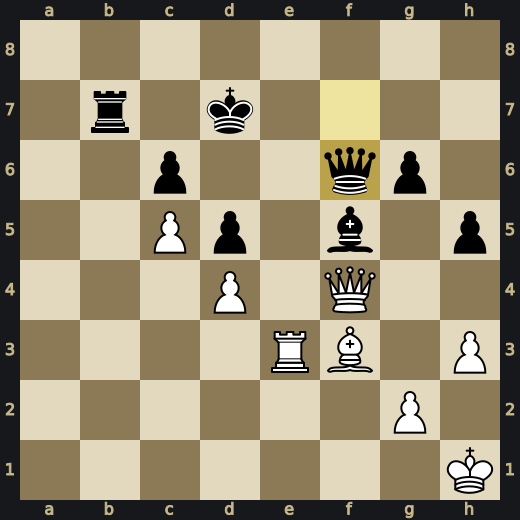
The simplest win was 49.Bxh5! gxh5 50.Re5, picking up the bishop on f5. The queens are still on the board, and White should convert this easily.
But her opponent didn't take it immediately. White started with 49.Re5?? and only then went for it with 50.Bxh5??.
What should Black play?
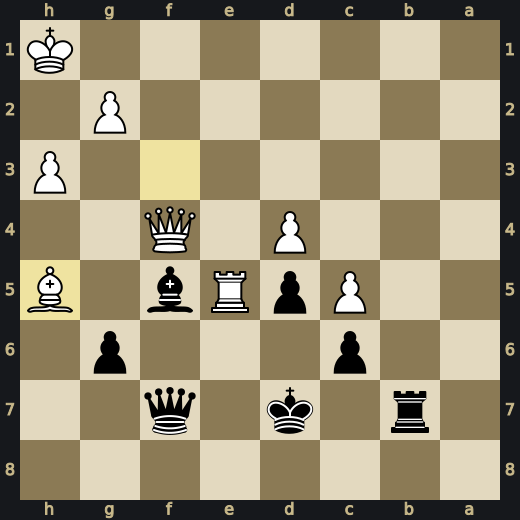
Savitha went 50...Be6!, and suddenly Black had real chances to hold. White's task had become much harder. White was forced to simplify the position and go into an endgame. Simplifying the position is very human, but usually it's much better to try to finish off the game when you can. As you keep dragging the game out, you end up giving more chances for your opponent and more chances for you to go wrong.
What should White play?
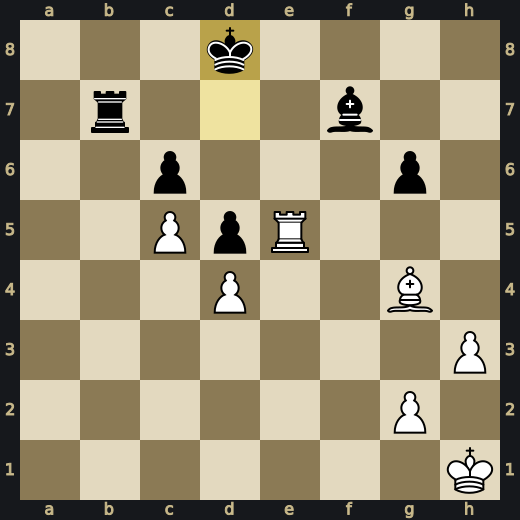
White had to go passive here, dropping the rook back with 53.Re2! to defend d4 with Rd2 next. The rook belongs on the second rank. The human move is 53.Re1, but after 53...Rb4 54.Rd1 g5 55.Kh2 Bg6 56.h4 gxh4 57.Kh3 Rb2, Black gets real counterplay with the rook. You can see how tricky the position is.
Many players simplify into the endgame unnecessarily, thinking that their risk is reduced. There is often a cost for this approach. You end up losing a portion of your advantage, forcing you to play very accurately.
In the game, White played 53.Be6?, misplacing the bishop. After 53...Be8, the d4 pawn was very hard to defend. After 54.Rg5, Black found a nice idea with 54...Rb1 55.Kh2 Re1, attacking the bishop.
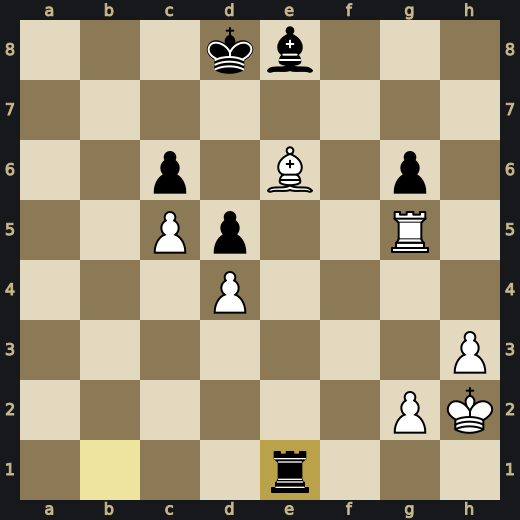
The bishop has no good square. On g4, it blocks the rook on g5. After 56.Re5, Black won the d4 pawn with 56...Rd1.
Black went on to win both the d4 and c5 pawns, but had to settle for a draw as White defended accurately from then on. It wasn't the win we wanted, but it secured a medal for the country.
The lesson of this game
A winning player, handed a position worth more than seven pawns, chose to simplify instead of finishing the job. And a lost player made it as difficult as possible, move after move, until the game came back to a draw. Simplifying felt like safety to one side. For the other, it was a gift.
The last board
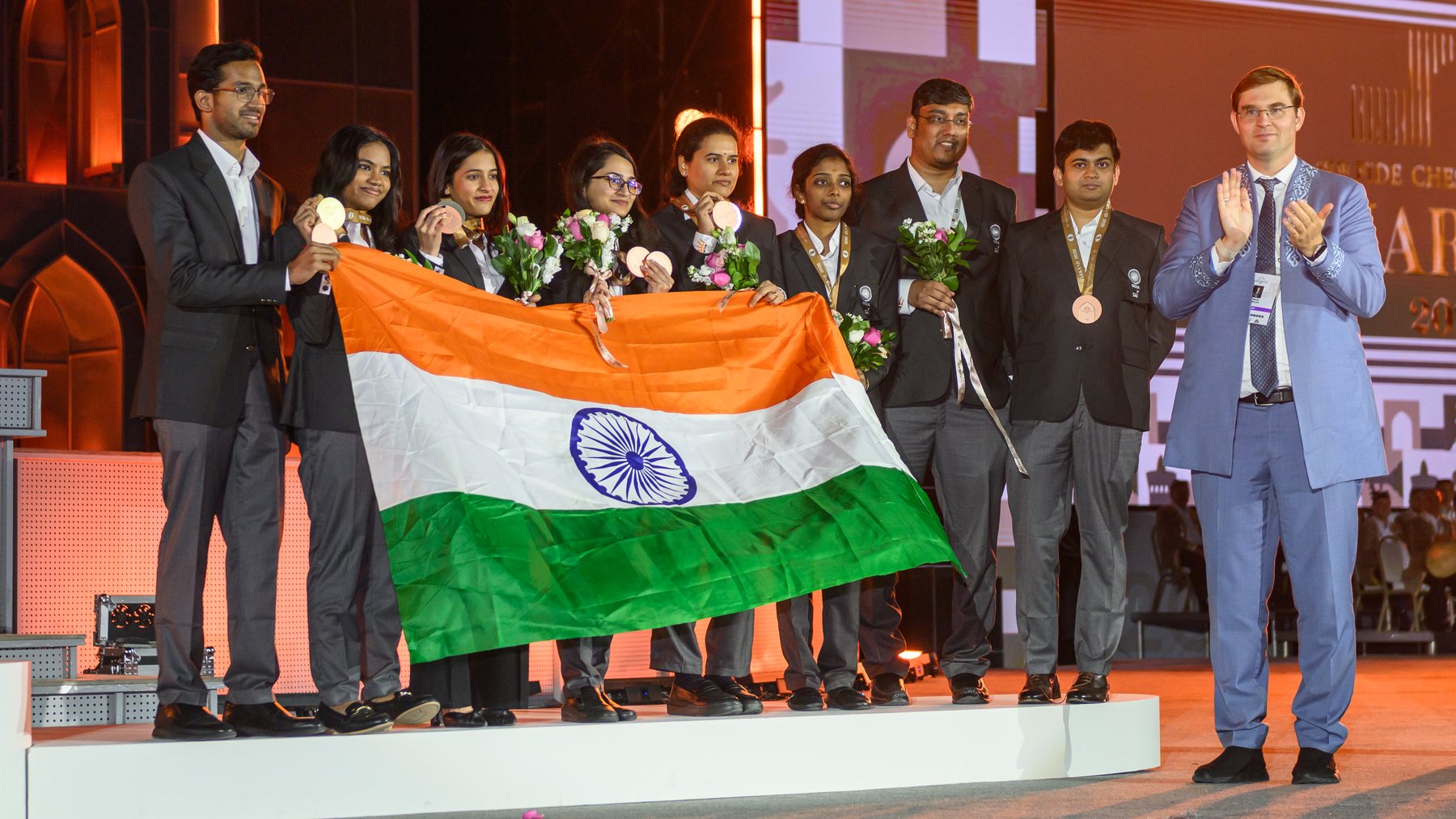
India took team bronze. Savitha finished on 9/10, a 2569 performance at her first Olympiad, and won the individual gold medal on the reserve board.
But the numbers aren't what stay with me. It's the picture from round 8: one hand pressed to her head, everyone else's game finished, the whole hall's attention narrowing to one board.
That is the loneliest seat in team chess.
Three times, the match came down to her, and each game showed the same thing from a different angle. Against Kazakhstan, her opponent played not to lose and ran out of time. Against China, the attacker passed on the sacrifice three times, and the defender never found hers. Against Georgia, the side that was winning simplified, and the side that was lost made it hard.
In every case, the decision came down to what you do with fear. Most of these moments aren't decided by talent.
Fear pushes you toward the safe move, the trade, the retreat, and the safe move is very often the one that loses.
The critical line is uncomfortable, but that's where the game gets decided. Play the position in front of you, not the result you're afraid of.
Imagine you're the last board standing. Savitha showed how to answer that question three times, with the whole team watching.