Old Habits · Part 2 of 2
Keep the Tension
Two winning positions released too early, and then the game where I finally kept control.
After five rounds I was on 5/5, but not convinced by the quality of my play. I had dodged a few bullets, as you saw in Part 1. This part is about what happened when the luck stopped.
Round 6: winning, then clarifying
In the sixth round I played an International Master, and I outplayed him completely out of the opening, with a plan from my latest Chessable course, A Complete Repertoire Against Everything but 1.e4. Step through the opening. My notes are on the moves.
Loading the board…
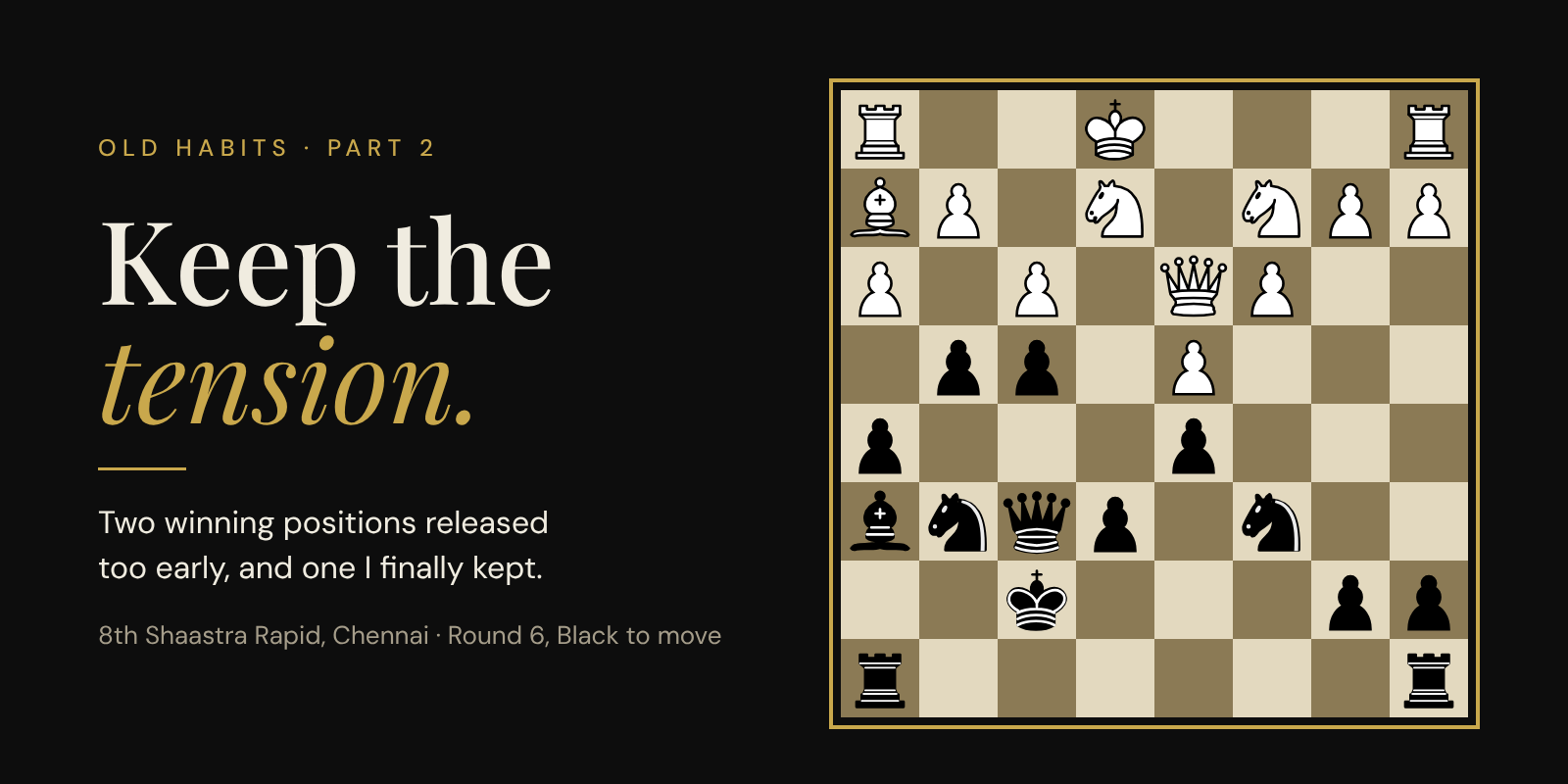
Before move 20, Black has a huge advantage. Now it is about converting it.
What should Black play?
Loading the board…
19...g3! The bishop on g1 is completely dead, and the rook is never coming into the game. Black is winning positionally, and there was nothing I had to do immediately.
Instead, I released the tension with 19...gxh3??, and White consolidated.
The game became very messy. Later I was completely winning again, but I blundered in time trouble. I should never have been short of time: had I kept control, there was nothing to think hard about. Instead I let him get counterplay and spent my time looking for a win. Time trouble generally favours the weaker side, because it makes everything unpredictable.
I also felt like my luck from the previous games had run out :)
Round 7: the same thing again
In the seventh round, my opponent chose a dubious opening, and I could sense that I should have an advantage here. This exercise has two questions.
What should White play?
Loading the board…
14.exf5! We have to trade these pawns and cannot allow Black to go ...f4. After 14...gxf5, 15.Qf3! is the move I missed: I give up the g5 pawn, recapture on h1 with the queen and go after Black's king.
Of course, I played 14.Bxf6 and gave my opponent very easy play.
Black exchanged their bad bishop, took over the centre and got a comfortable endgame. I tricked him at the very end and won, but Black was considerably better. The same mistake, again.
Round 8: redemption
Finally, a game I'm proud of. My opponent was a strong IM, very close to the GM title and rated 2485 in classical. I played a surprise idea I had prepared. I'm saving it for a future course :), so the game starts after that point.
Black has just played 10...a5, a logical move that many strong players have chosen, including Hikaru. It is a mistake. How should White react?
What should White play?
Loading the board…
11.a4! We blockade the queenside firmly. This is a rare case in an opposite-side castling middlegame where we take the time to stop the opponent's play on the queenside. Once we do it, we have free rein on the other flank.
Here is the whole game from move 10. On move 18, I could have taken the exchange, but I preferred to keep control and give no counterplay. I had learned my lesson from the sixth round.
Loading the board…
The last round
In the last round I drew with Black, without much chance to push. A win would have won the tournament. I finished third.
The takeaway
In rounds 6 and 7, I was winning early, and both times I released the tension when nothing forced me to. When you have an advantage, ask what kind it is. If it is static, like a dead bishop and a rook that will never come into the game, it will still be there in five moves. Keep control, don't give counterplay, and you won't need the time either.
When you are winning, you don't have to win right now. Keep the tension.
Knowing is not enough
I have tried to show you my games as honestly as I can. The point isn't my mistakes. It is to help you see your own.
But being aware of your weaknesses doesn't fix them. I work with many students, and I know my own issues very well. Without disciplined, regular training, they still come back once the clock is running. You play the way you have trained, not the way you know you should. So find the mistake that keeps coming back in your games, and train against it until the right decision becomes a habit.