Old Habits · Part 1 of 2
Dodging Bullets
Five rounds, five wins, and at least two games I should not have won.
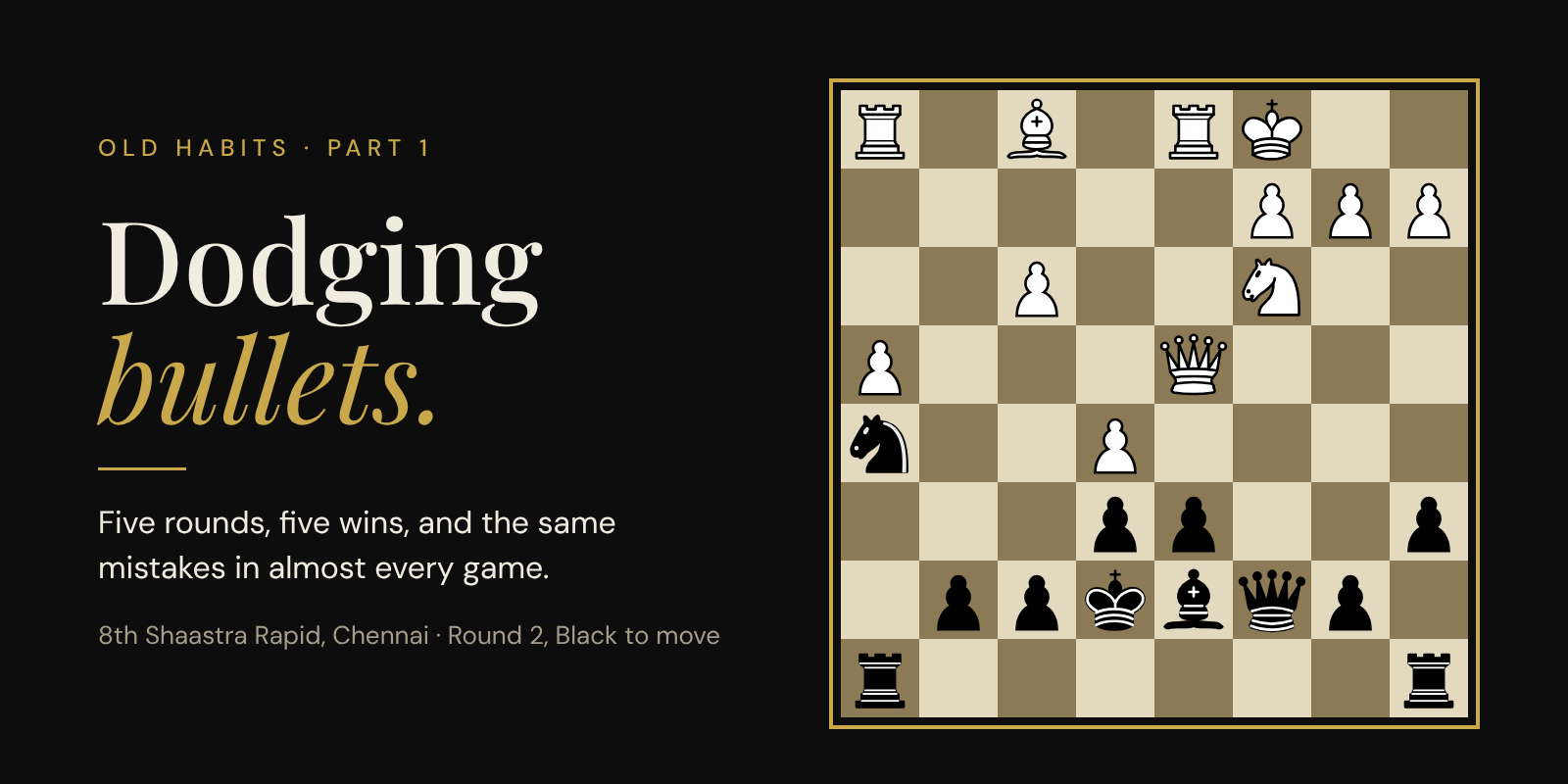
Last week, I played a rapid tournament near my house in Chennai, the 8th Shaastra FIDE Rated Rapid. For almost four years now, I have only been playing rapid and blitz events. Since I don't actively train, my weaknesses are very evident in most of my games. Even when I think about them consciously before a game, in the heat of the moment I end up making the same kind of mistakes. The way to fix this is, of course, to train properly at home for a long time and make the right decisions almost subconscious. Sadly, I usually lack the time and motivation to do this when I'm not playing classical chess :)
I will take you through the critical moments from my games. Even though none of them were broadcast, I wrote all of them down right after the event and analysed them. If you play seriously, you should do the same. Every game is an opportunity to learn, even a blitz game.
This is a very honest look at my own games. Most analysed games you see are the ones where things went right. These are the moments where my old habits cost me, and that is where the real lessons are.
Each position below is an exercise. Try it on the board before you read on. The clock is running, as it was for me.
Round 2: the academy T-shirt
I faced this in the second round against a very young player. The funny thing was that he was wearing the T-shirt of my old academy, a place where I spent a good eight years of my early childhood. I asked him briefly before the game, and he mentioned that he had the same coach I had back then.
Leaving all that aside, I was optimistic, as I was much higher rated. Until the previous move I was still in my preparation, but this was not the main line of my prep, and I had to figure it out over the board. The exercise has four questions, and you play both sides: my moves and my opponent's.
What should Black play?
Loading the board…
15...dxe5! You should take a central pawn whenever it can be done without too much danger. I considered it, but it looked too dangerous. I was thinking too vaguely, when I should have been concrete.
I played the natural 15...d5?, and we both missed things after that. The board has the whole story.
I definitely dodged a bullet there. The lesson is an old one for me: if a central pawn can be taken, check concretely whether it is safe, instead of trusting a feeling of danger.
Round 3: clarifying too much
In the third round I had White, and my bishop on g5 is attacked. How should I continue? This exercise has three questions, and the last one is for Black.
What should White play?
Loading the board…
15.O-O-O! I should just ignore the bishop on g5. If I don't capture on f6, Black cannot activate the light-squared bishop. Instead, 15.Bxf6? helped Black finish their development.
This is one of my issues: I tend to clarify the position a bit too much, because I do not like very complicated positions. It showed up again a few moves later, when I didn't push the d-pawn at once. Luckily, Black didn't blockade it, and the pawn decided the game.
Round 5: the blind spot
In the fifth round, I played creatively in the opening and sacrificed material. By now we were both down to seconds, and this is exactly the kind of position where I have to calculate precisely. That is where I struggle.
What should White play?
Loading the board…
30.h6! I had to go for it on the kingside. After 30...gxh6 31.Qf6!, the queen attacks the rook on h8 and breaks through. This was a complete blind spot for me.
Instead, I played 30.Be3?, a very typical move for me: I do not go for the critical line and just play something safe.
The same idea was there for the next few moves, and I missed it every time. Black took over, and I was defending an endgame until he blundered at the end. I was very lucky to win.
The pattern
Put the three games together and it is really the same mistake. When the position asks for a concrete, critical decision, I choose the move that feels safe. I didn't take on e5 because it looked dangerous. I took on f6 to clarify the position. I played Be3 instead of h6. None of these are calculation errors in the usual sense. They are habits.
Don't decide from a feeling of danger. Calculate the critical line.
After five rounds, I was on 5/5. Luck was on my side so far, but it can turn at any moment. That is where Part 2 begins.